ACORD standard forms have been the data architecture of P&C claims intake for decades. The ACORD 1 general property notice of loss, the ACORD 2 auto claims form, and the ACORD 4 homeowner property loss notice were developed to create a common field structure that carriers, agents, and claimants could use regardless of system or channel. As intake has moved from paper submission to electronic channels — IVR, web portal, mobile app, and structured EDI — the question is not whether to use ACORD field structure. It is how to ensure that electronic intake maps to that structure regardless of which channel the claimant used and which format the submission arrived in.
ACORD 1: General Property Notice of Loss
The ACORD 1 is the baseline first-report form for commercial and personal property losses. Its field structure captures: insured name and policy number; date and time of loss; location of loss; description of the occurrence; description of property damaged; whether police or fire reports exist; whether injuries were involved; and the reporting party's relationship to the insured. These fields are not arbitrary — they represent the minimum information set that determines whether a claim file is investigation-ready at creation.
In electronic intake, every one of these fields should be structured data in the CMS record, not free-text notes. A web portal that captures a claimant's description of a fire loss in an unstructured text box produces a claim file that requires a technician to read the text and manually populate the CMS fields. A portal designed to map to ACORD 1 field structure directly — prompting specifically for date of loss, time of loss, location, whether fire department was called, whether anyone was injured — produces a claim file with structured data at creation. The difference in downstream usability is significant: structured fields enable automated triage logic, coverage verification queries, and ISO ClaimSearch lookups; unstructured text does not.
For commercial property losses, the ACORD 1 also captures information about the nature of the insured's business operations and the business personal property potentially involved. This information is relevant to loss reserve adequacy at initial file creation. A commercial property adjuster who opens a file with the insured's business type, reported damage type, and location can form a more grounded initial reserve estimate than one who opens a file with "claimant reported water damage, further details to be obtained."
ACORD 2: Private Passenger Auto and Commercial Auto
The ACORD 2 auto claims form has distinct fields that distinguish it from general property FNOL: vehicle identification (year, make, model, VIN), driver information (name, license, relationship to insured), accident location and conditions, other parties involved (drivers, vehicles, witnesses), law enforcement information, and injury status. For commercial auto, additional fields capture vehicle use at time of loss and whether the vehicle was under cargo at time of the accident.
Auto FNOL submitted via mobile app or IVR frequently captures only a subset of ACORD 2 fields. An IVR intake that confirms policy number, date of loss, and a brief description routes the call to a claims intake queue but does not capture VIN, driver details, or other-party information. When the claims representative calls back to complete the intake, the time between the initial IVR capture and the completed FNOL record represents a window of intake latency that directly affects cycle time metrics and, in some cases, the regulatory acknowledgment clock.
Electronic intake designed with ACORD 2 field completeness as the target — either through a mobile-optimized portal that walks through required fields or through a structured callback protocol for phone and IVR submissions — closes this gap. The claim file that arrives at the adjuster queue with VIN confirmed, driver confirmed, other parties documented, and law enforcement case number captured is more investigation-ready than a file that requires the adjuster to obtain the same information in their initial contact call.
ACORD 4: Homeowner Property Loss Notice
The ACORD 4 is specific to homeowner property losses and captures fields relevant to that coverage structure: the property address (which may differ from the mailing address), the type of structure, occupancy status, mortgage information (relevant to loss payee instructions and subrogation), and specific questions about the cause of loss that feed directly into coverage analysis. A loss caused by surface water flooding is handled differently than a loss caused by a burst pipe even on the same property — ACORD 4's cause-of-loss fields are designed to capture that distinction at intake.
We are not saying that the ACORD form set is the final word on what electronic intake should capture. ACORD forms are a floor, not a ceiling. Carriers writing commercial property lines often supplement ACORD 1 fields with coverage-specific data points — blanket vs. scheduled property, business income waiting period, coinsurance provisions — that are not part of the standard ACORD 1 field set but are needed for an accurate initial reserve. The value of ACORD mapping is not that it exhausts the required data. The value is that it establishes a documented minimum that every FNOL must meet.
Channel Normalization: The Real Challenge
An ACORD-complete FNOL submitted by a captive agent through an agency management system arrives in the carrier's CMS with structured data because the agency management system maps its own fields to ACORD structure. A phone FNOL taken by an intake representative and typed into a screen produces whatever structure the CMS input form imposes — which may or may not match ACORD field requirements. A web portal submission produces whatever the portal developer designed the form to capture.
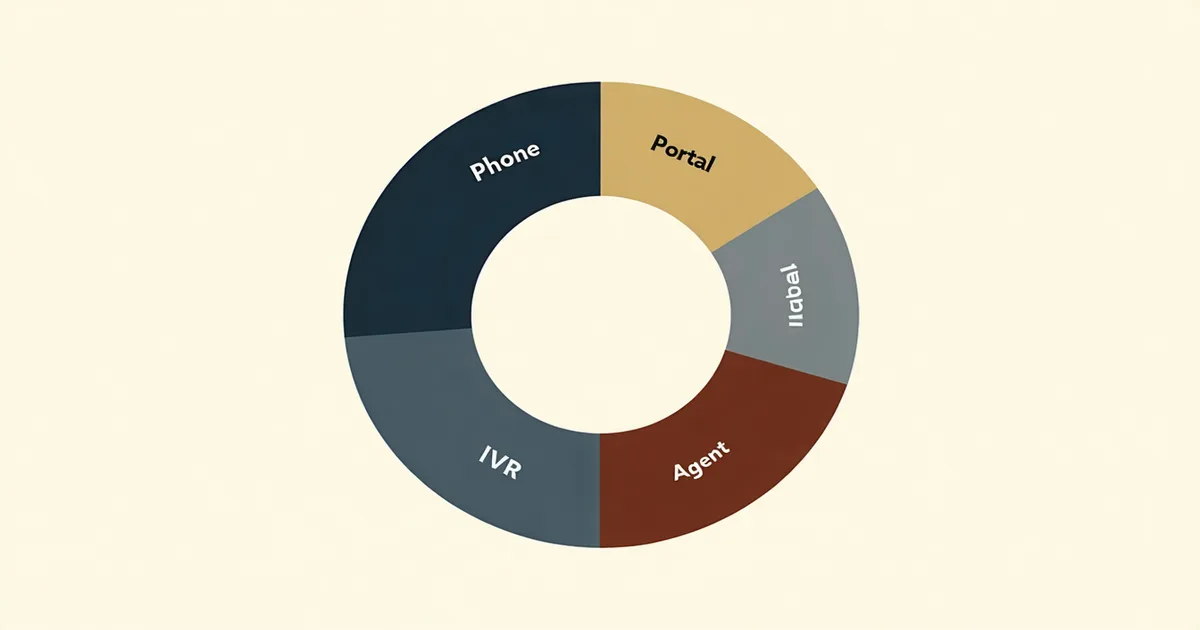
Carriers running multiple intake channels face a normalization problem: the same underlying claim, reported through different channels, arrives in the CMS with different field completeness. The phone intake file has fields that the portal file lacks; the agent submission has endorsement details that the direct claimant submission does not. The adjuster who receives files from different channels has to account for varying data completeness in their initial review.
Normalization means establishing ACORD field mapping as the canonical requirement for every intake channel and building or configuring each channel to meet that requirement. For IVR, this may mean building a callback workflow that collects missing fields when the IVR call is shorter than the ACORD minimum. For web portal, it means designing form logic that enforces required fields before submission. For email, it means a structured parsing layer that maps email-submitted loss information to ACORD fields before creating the CMS record.
A regional carrier writing personal and commercial lines across five northeastern states, processing roughly 1,200 FNOLs per month across phone, portal, and agent submission channels, will have meaningful field-completeness variance across channels unless normalization is explicitly designed into the intake architecture. The productivity cost of that variance — adjuster time spent on additional information-gathering calls that would have been unnecessary if intake had been complete — accumulates across every file that arrives below the ACORD minimum.
Electronic Data Interchange and CMS Integration
For carriers and MGAs that receive FNOL through EDI partners — wholesale brokers, program administrators, or large commercial accounts with their own loss reporting systems — ACORD mapping is the handshake protocol. ACORD AL3 transaction sets and the newer ACORD XML standards define the electronic interchange format. A carrier's CMS that accepts ACORD-structured EDI submissions can ingest these files with minimal manual intervention; a CMS that requires manual re-entry of EDI-submitted data eliminates the efficiency advantage of the electronic channel.
Guidewire ClaimCenter, Duck Creek Claims, and Insurity all support ACORD-structured intake through their standard APIs and configurable intake layers. The implementation question is whether the carrier has configured those intake layers to enforce ACORD field completeness on every submission, or whether the CMS accepts incomplete records that downstream processes must complete. Configuration, not platform capability, is usually the binding constraint.
Carriers evaluating whether their current intake captures ACORD-complete records across all channels can speak with the Fnolwise team about intake normalization design and what a structured first-report looks like when it arrives at the adjuster queue.